The Woman
The Woman is a minor but decisive figure in Arthur Miller's Death of a Salesman, a Boston buyer whose brief affair with Willy Loman becomes the single event that destroys Biff's faith in his father and, by extension, in the entire dream of success Willy had sold him. She appears only in Willy's memory and in the traumatic hotel-room scene, yet her laughter, her demands for silk stockings, and her casual intimacy with Willy expose the lie at the heart of the Loman household. She is the catalyst for Biff's disillusionment and the reason the family's carefully constructed narrative of being "well-liked" and destined for greatness shatters into recrimination and loss.
Identity and Role
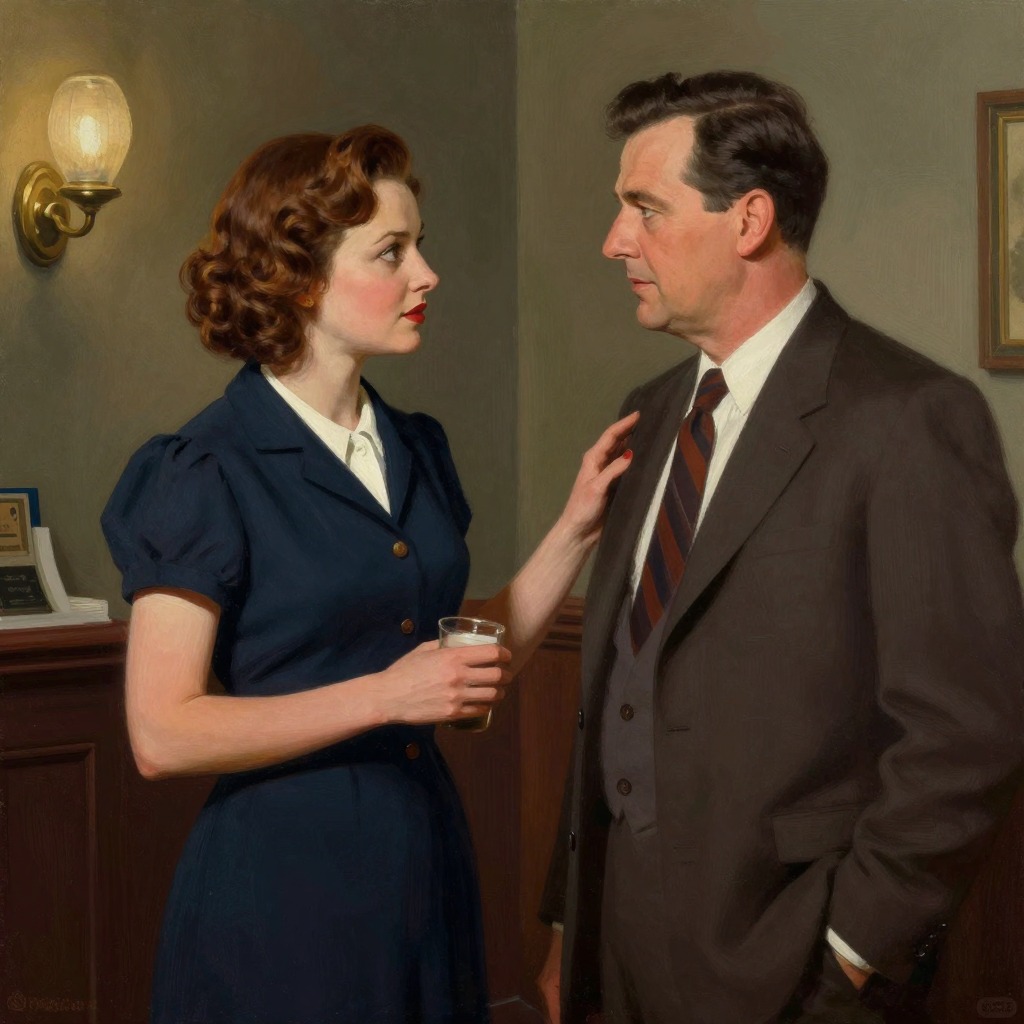
The Woman is a buyer for a Boston department store—she mentions J. H. Simmons—and she is described as "quite proper-looking, Willy's age." She works at a desk where she watches salesmen pass day in and day out, and she chose Willy, she tells him, because of his sense of humor: "You do make me laugh. It's good for me." She is not a seductress or a villain; she is a lonely woman who finds in Willy a companion who amuses her and who gives her gifts. She is also a practical figure who can put Willy "right through to the buyers," meaning their relationship has a transactional dimension that benefits his career. In the stage directions, she is first seen dimly behind a scrim, dressing and laughing, and her laughter blends with Linda's, creating a disturbing auditory overlap that suggests how deeply Willy's betrayal is woven into the fabric of his domestic life.
The Affair and Its Material Signs
The affair is marked by a specific, recurring object: silk stockings. The Woman reminds Willy, "You promised me stockings, Willy!" and when she appears in the hotel room she carries a box of "size nine sheers" that he has given her. These stockings are the physical evidence of his betrayal. In the same memory sequence, Linda is seen mending her own stockings at the kitchen table, and Willy, upon noticing, explodes: "I won't have you mending stockings in this house! Now throw them out!" His rage is a displaced guilt—he cannot bear to see Linda performing the domestic economy of repair while he has given new stockings to another woman. The stockings thus become a charged symbol of his divided life: one woman mends, the other receives; one is the object of his public devotion, the other of his private need.
The Boston Discovery and Its Consequences
The pivotal scene occurs in a Boston hotel room, the Standish Arms. Biff, having flunked math and traveled to Boston to ask his father to intercede with his teacher, knocks on the door. Willy, panicked, hides The Woman in the bathroom. When she emerges, laughing and lisping, in a black slip, Biff sees her and is struck silent. Willy tries to pass her off as a buyer named Miss Francis whose room is being painted, but the lie is transparent. The Woman, humiliated and angry, retrieves her stockings and says to Biff, "Are you football or baseball?" before leaving. Biff, weeping, accuses his father: "You—you gave her Mama's stockings!" He calls Willy a "liar" and a "phony little fake," and from that moment his life loses its direction. Bernard later recalls that after Biff returned from Boston, he took his prized sneakers—the ones printed with "University of Virginia"—down to the cellar and burned them in the furnace. The discovery of the affair is the wound from which Biff never recovers, the reason he abandons the path of success and becomes, in his own words, "a dime a dozen."
Narrative Function and Thematic Significance
The Woman is not a fully developed character; she has no name beyond her generic title, and her own story is never told. She exists entirely within Willy's memory and within the single traumatic scene that Biff carries for fifteen years. This structural marginalization is itself thematically significant. She is a woman whose body and labor—both sexual and professional—are used by Willy to sustain his sense of being "well-liked" and to compensate for his loneliness on the road. Yet she is also the agent of his unmasking. Her laughter, which recurs in Willy's mind at moments of stress, is the sound of the truth he cannot contain. In the play's moral economy, she is the figure who exposes the gap between Willy's public performance of success and his private desperation. She is, finally, the reason Biff can say at the grave, "He had the wrong dreams. All, all, wrong." Without her, the dream might have remained intact; with her, it is revealed as a lie.